
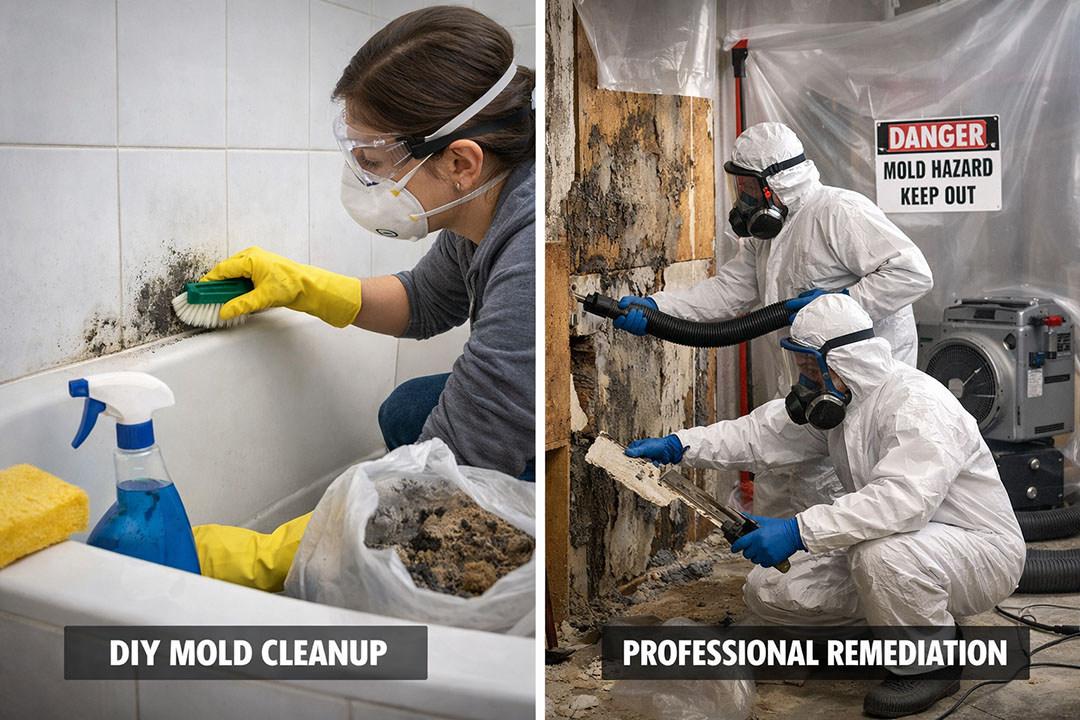
Whether you should clean mold yourself or hire specialists comes down to three things: the size of the problem, the location and cause, and the health and risk factors involved. For small, surface‑level issues you can usually DIY safely, but larger, hidden, or health‑related situations are better handled by professionals.
When DIY mold cleanup is reasonable
Authorities and industry guides generally agree that small mold problems on hard surfaces are appropriate for homeowners to handle themselves. DIY is usually acceptable when:
- The moldy area is small – commonly cited as less than about 10 square feet (e.g., a patch on bathroom tile or along a window frame).
- The growth is on non‑porous or semi‑porous surfaces, like glazed tile, metal, glass, or finished hard surfaces, and the material is otherwise sound.
- The moisture source is minor and already fixed, such as a brief condensation issue or a small, repaired plumbing drip that did not soak surrounding materials for long.
- You and other occupants do not have significant mold‑related health vulnerabilities, such as severe asthma, strong allergies, immune compromise, or serious respiratory disease.
In these cases, recommended DIY steps include fixing the moisture problem, scrubbing mold off hard surfaces with detergent and water, and drying the area thoroughly so it does not return.
How to clean mold safely yourself
If your situation fits the “small and simple” criteria, treat the cleanup as a controlled project, not a quick wipe‑down. Good practice includes:
- Protect yourself: Wear non‑porous gloves, an N95 or similar mask, and eye protection while cleaning to reduce inhalation and contact.
- Limit disturbance: Avoid dry brushing or power‑washing indoors, which can send spores airborne; use damp cleaning methods instead.
- Clean, then dry: Scrub visible mold from hard surfaces with a mild detergent solution, rinse if needed, and dry completely with fans or dehumidifiers.
- Discard unsalvageable porous items: If small porous items like cardboard boxes, old ceiling tiles, or moldy rugs are affected, it is usually safer to bag and discard them instead of trying to save them.
Even with DIY, the most important step is always eliminating the moisture source, or the mold will likely return.
Clear signs you should hire specialists
There are well‑recognized thresholds where expert sources strongly advise professional remediation instead of DIY. You should plan to hire specialists when:
- The area is large: Mold affects more than about 10 square feet, or there are multiple patches in different rooms, suggesting a widespread issue.
- Hidden mold is suspected: You have persistent musty odors, past leaks, or wall/ceiling damage, but little visible mold, indicating possible growth in wall cavities, ceilings, under floors, or inside insulation.
- HVAC systems are involved: Mold appears in or near ductwork, air handlers, or inside the HVAC system, where spores can spread throughout the building.
- Water was contaminated: The mold follows sewage, flooding, or gray/black water events, which carry additional pathogens and require special precautions.
- Structural damage or rot is present: Wood framing, subflooring, or other structural components are softened, crumbling, or decayed.
- Health concerns are significant: Occupants have strong mold sensitivities, asthma flare‑ups, or other health issues that may worsen with exposure during cleanup.
In these situations, professionals bring containment, filtration, and removal techniques that are difficult to replicate safely with household tools.
What professionals do differently
Specialized mold remediation goes beyond “stronger chemicals.” It is a structured process designed to remove growth, protect occupants, and prevent spread. Typical professional work includes:
- Assessment and planning: Evaluating moisture sources, mapping affected areas, and choosing appropriate containment and removal methods.
- Containment: Using plastic barriers, negative air machines, and controlled entry/exit to keep spores from spreading to clean areas.
- Air filtration: Operating HEPA air scrubbers and negative pressure systems to capture airborne spores during demolition and cleaning.
- Removal of mold‑damaged materials: Safely removing and bagging contaminated drywall, insulation, carpets, and other porous materials, followed by HEPA vacuuming and detailed cleaning.
- Verification and prevention: Checking that moisture is resolved, visible mold and odors are gone, and conditions will not support regrowth.
This approach reduces the chance of cross‑contamination and incomplete cleanup, which are common risks when large or complex jobs are done DIY.
Cost, risk, and decision trade‑offs
The decision is not only technical; it also involves cost, time, and risk tolerance. Guides that compare DIY and professional approaches note:
- DIY often has lower direct cost (cleaning supplies, basic protective gear) but higher risk of exposure and incomplete removal, especially if the problem is larger than it appears.
- Professional remediation costs more upfront but usually offers more thorough cleanup, better protection of unaffected areas, and sometimes warranties or guarantees on the work.
If mold returns quickly after DIY cleaning, or if you keep discovering new affected areas, that is a strong signal the problem is deeper than a homeowner job and that hiring specialists is the more economical choice in the long run.
A practical way to decide
If you are staring at mold and trying to choose a path, a simple framework can help:
- DIY is usually appropriate when:
- The area is small (<10 sq ft) and clearly defined.
- It is on hard, non‑porous surfaces without structural damage.
- The leak or moisture source is minor and already fixed.
- No one in the home has significant mold‑related health vulnerabilities.
- Hire specialists when:
- The problem is large, recurring, or hidden.
- Mold is tied to major water damage, contaminated water, or HVAC systems.
- There are health concerns or you are unsure how to contain and clean safely.
In all cases, remember that successful mold remediation, DIY or professional, depends on fixing the moisture problem first, then thoroughly removing mold‑contaminated materials and drying the area. When in doubt about the size, source, or health implications of what you are seeing, consulting a qualified mold specialist is usually the safest and most cost‑effective next step.
 Welcome to the Melbourne Mold website. If you have any questions regarding mold at your home or business premises - we are here to help. Please call or complete the form to the right, and we will be in touch at the earliest opportunity.
~ Greg Bertaux