
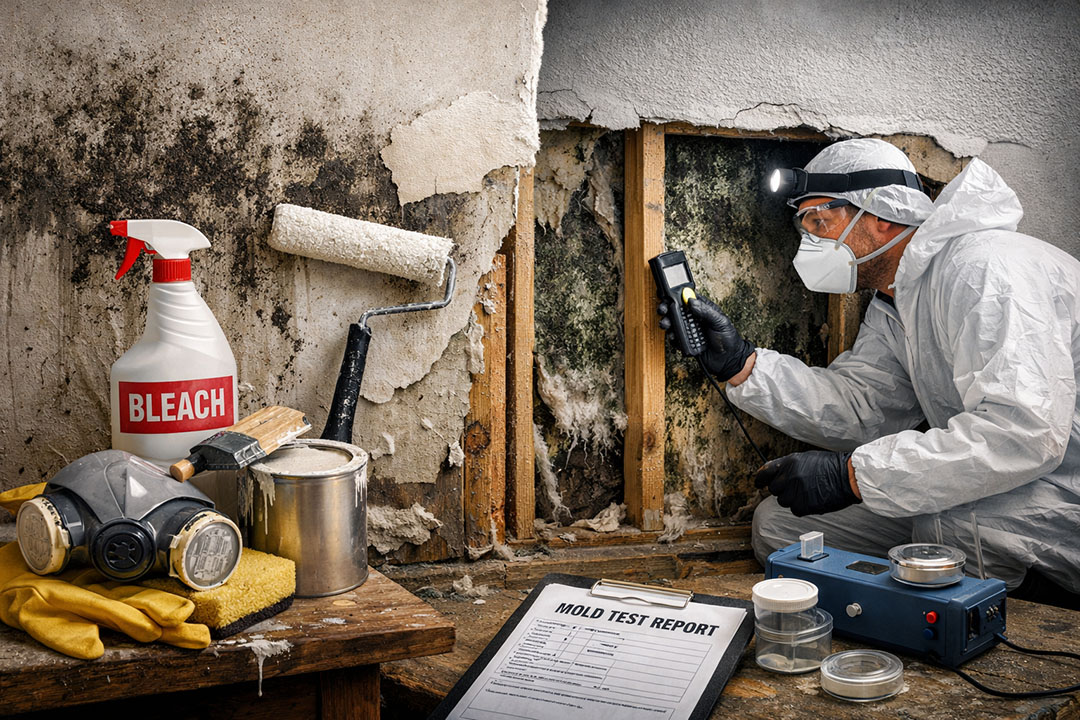
Mold is one of those topics where strong opinions, half‑truths, and outright myths spread faster than the fungus itself. When you are worried about your home or your health, those myths can push you into spending too much on the wrong things—or not enough on what truly matters. As a mold testing professional, I see the financial fallout of bad information all the time: unnecessary “emergency” work, failed DIY jobs, and homes that quietly deteriorate because the owner was told to “just paint over it.”
Below are some of the most expensive mold myths, why they are wrong, and what to do instead so you protect both your home and your budget.
Myth 1: “If I can’t see mold, I don’t have a problem”
This myth is expensive because by the time you can see mold, it has often been growing for a while. Mold thrives where there is moisture and organic material: inside wall cavities, behind cabinets, under flooring, inside HVAC systems. These areas are not part of your daily visual inspection, and yet they are some of the most common locations for hidden growth.
Early warning signs are usually indirect: musty or earthy odors, chronic humidity, recurring allergy‑like symptoms in certain rooms, or a history of leaks that were “towel‑dried” but never properly dried with dehumidification or air movement. Ignoring these clues because “I don’t see anything” allows moisture to continue damaging materials. By the time visible mold finally appears, you may be facing larger demolition, more extensive cleaning, and possible structural repairs.
The better rule: if moisture has been present for more than 24–48 hours in a confined area, assume there is a potential mold risk and investigate, even if nothing is yet visible. Testing and a thorough inspection are often cheaper than the repairs that come from waiting too long.
Myth 2: “If it’s not black, it’s not dangerous”
“Black mold” has become a catch‑all phrase, and it leads many people to dismiss anything that is not dark in color. In reality, mold comes in many colors—white, green, gray, orange, even nearly invisible when it’s just a light fuzz on drywall. Color alone tells you very little about how much damage it can cause to building materials or how irritating it might be to some occupants.
Common water‑damage molds, even when they are pale or light‑colored, feed on drywall paper, wood, and dust. Given enough time, they can undermine the integrity of materials and require replacement. From a practical standpoint, the key questions are: Is this growth linked to moisture? Is it spreading? Is it impacting indoor air quality? Focusing only on “black mold” causes homeowners to ignore other problematic growth and delays remediation until the problem is larger and more expensive.
A more useful mindset: any mold growth that is active and tied to a moisture problem is worth addressing, regardless of color or nickname.
Myth 3: “Bleach solves mold problems”
This is one of the most costly myths, because it encourages false confidence. Bleach can lighten or discolor surfaces so they look better in the short term, but that does not mean the problem is gone. On porous materials such as drywall, wood, and caulk, bleach does not reliably penetrate deeply enough to neutralize growth within the material. You end up bleaching the “tip of the iceberg” while roots and spores remain.
Bleach use can also introduce other issues. It may damage certain building materials, corrode metals, and create strong fumes in poorly ventilated spaces. In some cases, people repeatedly bleach the same areas, thinking they are “keeping it under control,” while the real issue – a leak, condensation, or high humidity – continues unchecked behind the scenes. Each cycle of superficial cleaning delays proper remediation and increases long‑term repair costs.
The better approach is two‑fold: first, eliminate the moisture source; second, physically remove mold‑contaminated materials that cannot be effectively cleaned (like saturated drywall) and professionally clean those that can. Cleaning agents and methods should be selected for the material and situation, not by reflexively reaching for bleach.
Myth 4: “A fresh coat of paint will seal it in”
Painting over stained drywall, ceilings, or baseboards is a common “quick fix” when selling a home or refreshing a space. The problem is that paint is not a solution for moist or contaminated materials. If mold is still active or the underlying surface is damp, new paint can blister, peel, or discolor quickly. In the meantime, the moisture problem continues to break down what’s underneath.
Using paint or “stain‑blocking primers” without first correcting moisture and addressing contamination is like putting a bandage on an untreated infection. It may hide the problem from view, but it does nothing to fix the cause. Later, when the staining comes back or the buyer’s inspector finds hidden damage, you are now facing not only the cost of real repairs but also potential trust and disclosure issues.
The cost‑effective path is to treat paint as a final cosmetic step after the moisture has been fixed and any necessary remediation is completed—not as a shortcut around those steps.
Myth 5: “If I run a dehumidifier, I don’t need anything else”
Dehumidifiers are very useful tools, especially in damp basements, crawlspaces, and humid climates. But they are not magical shields against all mold issues. A dehumidifier can reduce airborne moisture; it cannot fix a roof leak, a plumbing drip inside a wall, groundwater intrusion, or poor grading around the foundation.
Relying solely on a dehumidifier can lull homeowners into ignoring structural and drainage problems. Over time, water continues to infiltrate specific areas, materials stay wet enough for mold and rot, and the eventual repairs are far more expensive than addressing the root cause early. A dehumidifier should be part of a broader moisture‑control strategy, not the entire strategy.
Think of it as support, not a substitute: it helps maintain general humidity levels, but you still need to track and repair point‑source leaks and manage water outside the building.
Myth 6: “All mold tests are the same, so I’ll just buy the cheapest kit”
DIY test kits can seem like a budget‑friendly way to get answers, but misunderstanding what they can and cannot tell you can lead to very costly missteps. Many over‑the‑counter kits simply show that mold spores exist which is almost always true, indoors and outdoors. Without a clear sampling strategy, proper collection, and professional interpretation, results can be misleading.
If a kit shows growth, some homeowners panic and authorize unnecessary, broad‑brush remediation. If a kit appears “negative,” others assume everything is fine and ignore ongoing moisture issues. In both cases, money is spent based on incomplete information. Professional sampling aims to answer targeted questions: Where might there be hidden growth? Are indoor levels elevated compared to outdoors? Which locations should be prioritized for investigation or remediation?
The most cost‑effective testing is not always the cheapest upfront; it is the testing that gives you actionable information about sources, extent, and priorities so you do not overspend or underspend in the wrong areas.
Myth 7: “If I hire the biggest company, I must be getting the best job”
Reputation and size are not guarantees of a good fit for your particular situation. Some companies specialize in large loss projects and may recommend aggressive, expensive approaches that exceed what is actually needed in a smaller home or limited‑area issue. Others offer “one‑size‑fits‑all” packages that do not account for the specifics of your building, budget, or timeline.
A more protective approach is to separate the roles: use an independent inspector or testing professional to assess the problem and define what remediation should include, then obtain quotes from multiple qualified remediation companies based on that scope. When the assessment and the cleanup are not driven by the same party, you reduce the risk of overselling, change orders, and unnecessary work.
Turning knowledge into savings
Understanding these mold myths is not just about winning an argument at a dinner party; it is about protecting your home and finances. When you know that visibility, color, bleach, paint, and generic gadgets are not silver bullets, you are far less likely to throw money at the wrong solution. Instead, you can focus on the fundamentals that actually matter: controlling moisture, investigating suspicious areas early, getting targeted testing when appropriate, and choosing remediation that is right‑sized for the problem.
That mindset transforms mold from a frightening, mysterious threat into a manageable building science issue—one where good information is your best investment.
 Welcome to the Melbourne Mold website. If you have any questions regarding mold at your home or business premises - we are here to help. Please call or complete the form to the right, and we will be in touch at the earliest opportunity.
~ Greg Bertaux