
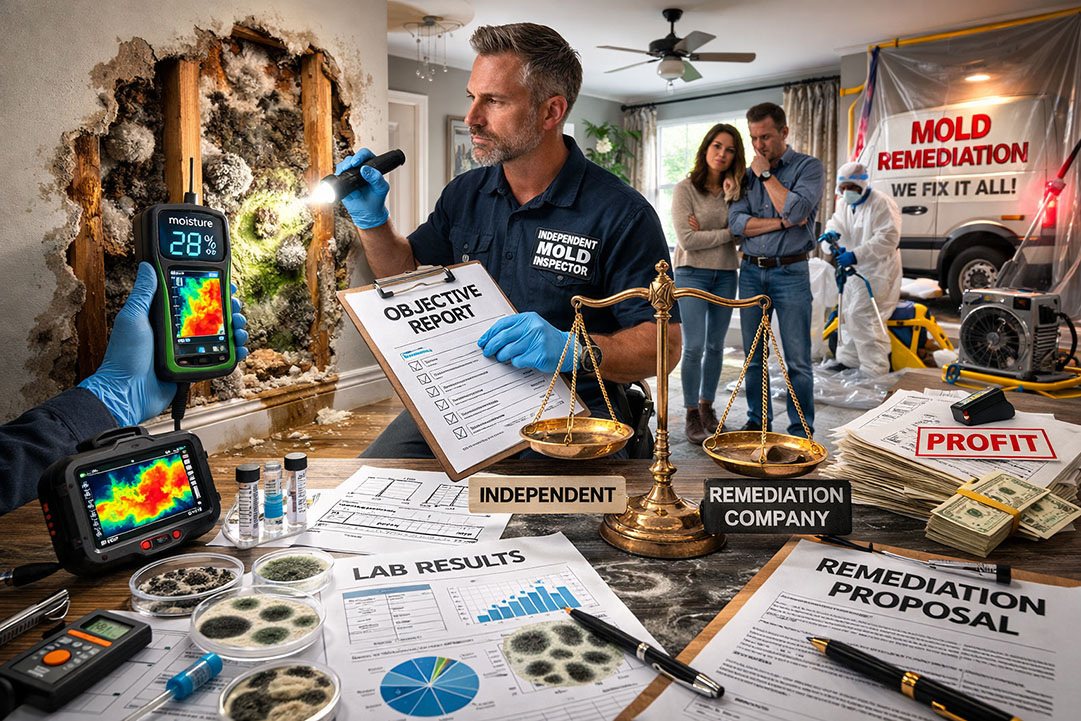
When mold is suspected in a Florida home or commercial building, the first step is not just a practical decision – it is a legal one.
Under Florida law, mold assessment and mold remediation are legally separate services. In most cases, it is illegal for a remediation company to perform the initial mold inspection or assessment. Even more importantly, the company that performs the assessment is legally barred from performing the remediation on that same project.
This is not simply a “best practice.” It is state law.
Failing to understand this distinction can expose property owners to regulatory violations, invalid reports, insurance complications, and unnecessary financial risk.
Below is what Florida property owners need to know.
- Florida Law Requires Separation of Assessment and Remediation
Florida regulates mold services under the Florida Mold-Related Services licensing statutes.
There are two distinct licenses:
- Mold Assessor License
- Mold Remediator License
They are not interchangeable.
Most mold remediation companies in Florida are not licensed mold assessors, meaning they cannot legally perform the initial inspection, sampling, moisture mapping, or scope development.
Even if a company holds both licenses, Florida law prohibits the same company from performing mold assessment and remediation on the same property. The assessor who identifies and defines the scope of work cannot financially benefit from performing the cleanup.
This legal firewall exists to prevent conflicts of interest and protect consumers.
- Conflict of Interest Is Not Just a Risk — It Is the Reason for the Law
Florida created this separation specifically to eliminate financial bias.
A remediation company profits from finding contamination. An independent mold assessor does not.
That distinction matters.
An independent assessor’s role is limited to:
- Identifying moisture intrusion sources
- Performing air and surface sampling
- Conducting thermal imaging and moisture mapping
- Interpreting laboratory analysis
- Writing an objective remediation protocol
Because they are legally prohibited from performing the cleanup, their findings are impartial and defensible.
This is especially critical in:
- Insurance claims
- Real estate disputes
- Landlord-tenant conflicts
- Litigation involving health complaints
Reports generated by licensed, independent mold assessors carry greater legal credibility because they are not tied to remediation revenue.
- Remediation Companies Typically Cannot Perform Legal Assessments
Many property owners assume that any mold company can “take a look and test.”
In Florida, that assumption is often incorrect.
Unless the company holds a valid Florida Mold Assessor License, they cannot legally:
- Perform mold testing
- Provide a formal mold assessment
- Write a remediation protocol
- Determine the scope of contamination
If an unlicensed contractor performs assessment activities, it may invalidate reports, create insurance issues, and expose the property owner to regulatory complications.
Hiring a licensed independent assessor ensures compliance from the beginning.
- The Assessing Company Cannot Perform the Remediation
Even when a firm holds both licenses, Florida law prohibits the assessor from remediating the same property they evaluated.
Why?
Because allowing the same company to diagnose and profit from cleanup creates a structural incentive to overstate contamination.
The law forces separation to protect the consumer.
This also applies to post-remediation verification (PRV), sometimes called clearance testing.
A remediation company cannot “grade its own work.”
An independent assessor must:
- Establish pre-remediation baseline conditions
- Define the scope of remediation
- Perform post-remediation clearance testing
- Verify that spore levels have returned to normal ecological ranges
Without independent clearance, there is no objective confirmation the problem has been corrected.
- Accurate Scope of Work Prevents Over-Remediation
When assessment and remediation are bundled (illegally or improperly), over-remediation is common.
Property owners may be advised to:
- Remove excessive drywall
- Demolish unaffected areas
- Replace materials that could have been dried
- Perform full-structure remediation unnecessarily
A licensed independent assessor defines the true extent of contamination based on data — not profit.
This frequently reduces costs and protects structural integrity, especially in:
- Luxury homes
- Historic properties
- Commercial buildings
- Multi-unit developments
- Stronger Legal and Insurance Documentation
In Florida, mold claims often intersect with:
- Property insurance disputes
- Real estate transactions
- Construction defect claims
- Habitability complaints
Independent assessors provide:
- Third-party laboratory documentation
- Chain-of-custody records
- Moisture intrusion analysis
- Causation reporting
- Scientifically supported remediation protocols
Because they are legally separated from the cleanup contractor, their reports are far more defensible in court and during insurance review.
Attorneys and adjusters routinely give greater weight to independent assessments.
- Mold Is a Moisture Problem – Not Just a Cleanup Issue
Mold growth is almost always caused by:
- Roof leaks
- Plumbing failures
- HVAC design defects
- Humidity imbalance
- Building envelope intrusion
A remediation contractor focuses on removal.
A licensed mold assessor focuses on why it occurred.
Without correcting the moisture source, mold will return, regardless of how aggressive the remediation was.
Independent assessment ensures the underlying cause is identified and documented.
- Financial Protection Through Legal Compliance
Mold remediation can be expensive in Florida, particularly in high-value properties.
Hiring a licensed independent assessor first allows you to:
- Define the scope properly
- Obtain competitive bids from remediation contractors
- Avoid unnecessary demolition
- Ensure legal compliance
- Prevent repeat contamination
In many cases, independent assessment saves significantly more than it costs.
Conclusion
In Florida, separating mold assessment from remediation is not optional, it is required by law.
Most remediation companies are not licensed to perform assessments. And even if they are, they cannot legally remediate the same property they evaluated.
This legal structure exists to protect property owners from conflicts of interest, inflated scopes, and biased reporting.
When mold is suspected, the correct and lawful first step is to hire a licensed independent mold assessor.
Remediation companies serve an important purpose, but in Florida, their role is execution, not diagnosis.
For property owners concerned about liability, insurance coverage, health complaints, or high-value real estate transactions, independent mold assessment is not just advisable.
It is essential.
 Welcome to the Melbourne Mold website. If you have any questions regarding mold at your home or business premises - we are here to help. Please call or complete the form to the right, and we will be in touch at the earliest opportunity.
~ Greg Bertaux