
When people start investigating possible mold problems in their home or workplace, one of the most common points of confusion is the difference between mold spore testing and mycotoxin testing. While both relate to mold exposure, they serve very different purposes, use different methods, and answer different questions.
Understanding this distinction is critical if you want accurate answers about your indoor environment and your health.
What Is Mold Spore Testing?
Mold spore testing is the standard method used in professional mold inspections. It focuses on detecting and identifying the presence, type, and concentration of mold spores in the air or on surfaces.
How It Works
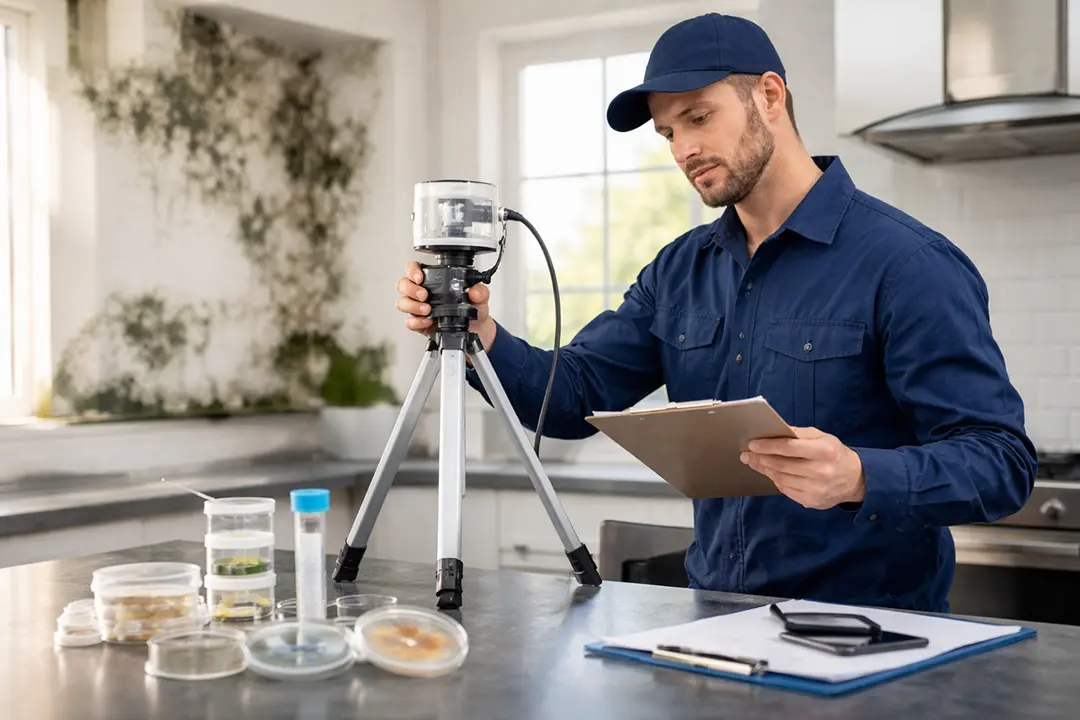
A certified inspector collects samples using one or more of the following methods:
- Air sampling (spore traps): Captures airborne particles over a set period
- Surface sampling (tape lifts or swabs): Tests visible growth or suspect areas
- Bulk sampling: Analyzes pieces of contaminated materials
These samples are sent to a laboratory where they are examined under a microscope or with AI-assisted imaging systems to identify mold types and quantify spore levels.
What It Tells You
Mold spore testing answers key environmental questions:
- Is mold present in the home or building?
- What types of mold are present?
- Are indoor spore levels elevated compared to outdoor levels?
- Where is the likely source of mold growth?
This is essential information for identifying hidden mold problems, especially in areas like behind walls, under flooring, or inside HVAC systems.
What Is Mycotoxin Testing?
Mycotoxin testing focuses on detecting toxic compounds produced by certain molds, rather than the mold organisms themselves.
What Are Mycotoxins?
Mycotoxins are secondary metabolites produced by some species of mold under specific environmental conditions. Not all molds produce mycotoxins, and even those that can do so only produce them under certain circumstances.
Common mycotoxin-producing molds include:
- Stachybotrys (often called “black mold”)
- Aspergillus
- Fusarium
- Penicillium
How Mycotoxin Testing Works
There are two primary types of mycotoxin testing:
- Environmental testing (dust sampling):
Dust is collected from a home or building and analyzed for the presence of mycotoxins. - Biological testing (urine or blood tests):
Conducted through medical providers to assess whether a person has been exposed to mycotoxins.
What It Tells You
Mycotoxin testing attempts to answer:
- Are toxic compounds from mold present in the environment?
- Has a person been exposed to mold-related toxins?
However, it does not identify the location of mold growth or determine whether there is an active mold problem in the building.
Key Differences Between Mold Spore Testing and Mycotoxin Testing
Understanding how these two testing methods differ can help you choose the right approach.
- Purpose
- Mold Spore Testing: Identifies mold presence and source
- Mycotoxin Testing: Detects potential toxic byproducts
- Focus
- Mold Spore Testing: The mold organism itself
- Mycotoxin Testing: Chemicals produced by some molds
- Use Case
- Mold Spore Testing: Property inspection, real estate, indoor air quality assessments
- Mycotoxin Testing: Health investigations, often guided by medical professionals
- Reliability for Building Diagnosis
- Mold Spore Testing: Highly reliable for identifying indoor mold problems
- Mycotoxin Testing: Limited usefulness for locating or confirming mold growth in a structure
Why Mold Spore Testing Is the First Step
If you suspect mold in your home or business, mold spore testing should almost always come first.
Here’s why:
It Identifies the Source
Mold spore testing helps pinpoint where mold is growing, even if it is hidden. Mycotoxin testing cannot do this.
It Provides Actionable Data
You can use spore testing results to:
- Determine whether remediation is needed
- Guide remediation professionals
- Verify that cleanup was successful
It Reflects Real-Time Conditions
Air and surface samples show what is actively present in your environment right now.
Limitations of Mycotoxin Testing
While mycotoxin testing has its place, especially in medical contexts, it comes with several important limitations when used for building investigations.
It Does Not Locate Mold
You may detect mycotoxins in dust, but this does not tell you where the mold is growing or how to fix the problem.
Results Can Be Misleading
Mycotoxins can come from multiple sources, including food. A positive result does not necessarily mean your home has a mold issue.
Not All Mold Produces Toxins
Even if mold is present, it may not be producing mycotoxins at detectable levels.
When Should You Consider Mycotoxin Testing?
Mycotoxin testing may be appropriate in specific situations:
- You are working with a healthcare provider to investigate chronic symptoms
- Mold spore testing has already confirmed a mold problem
- You want additional data about potential toxin exposure
In these cases, it should be used as a complement, not a replacement, for proper mold inspection.
Common Misconceptions
“Mycotoxin Testing Is More Advanced”
Many people assume mycotoxin testing is a more advanced or superior option. In reality, it simply measures something different and is not a substitute for identifying mold growth.
“No Mycotoxins Means No Mold”
This is incorrect. Mold can be present without producing detectable toxins.
“You Only Need One Type of Test”
In some cases, both tests may be useful, but they serve different purposes and should not be confused.
Choosing the Right Testing Approach
If your goal is to evaluate your home or building, start with:
✔ Professional mold inspection
✔ Air and surface sampling
✔ Laboratory analysis of mold spores
If your concern is health-related, consult a qualified medical professional about whether mycotoxin testing is appropriate.
Final Thoughts
Mold spore testing and mycotoxin testing are often discussed together, but they are fundamentally different tools.
- Mold spore testing tells you what is in your environment and where it is coming from
- Mycotoxin testing may help evaluate exposure to certain toxic compounds
For homeowners and property managers, the priority should always be identifying and addressing the source of mold growth, and that starts with proper mold testing.
Need Clear Answers About Mold in Your Home?
If you suspect mold in your property, guessing is not a strategy. You need accurate, unbiased data.
Melbourne Mold specializes in professional mold inspection and testing only, so you get clear results without any conflict of interest from remediation services.
Call 1-321-574-5503 today to schedule your inspection and take the first step toward a healthier indoor environment.
 Welcome to the Melbourne Mold website. If you have any questions regarding mold at your home or business premises - we are here to help. Please call or complete the form to the right, and we will be in touch at the earliest opportunity.
~ Greg Bertaux