
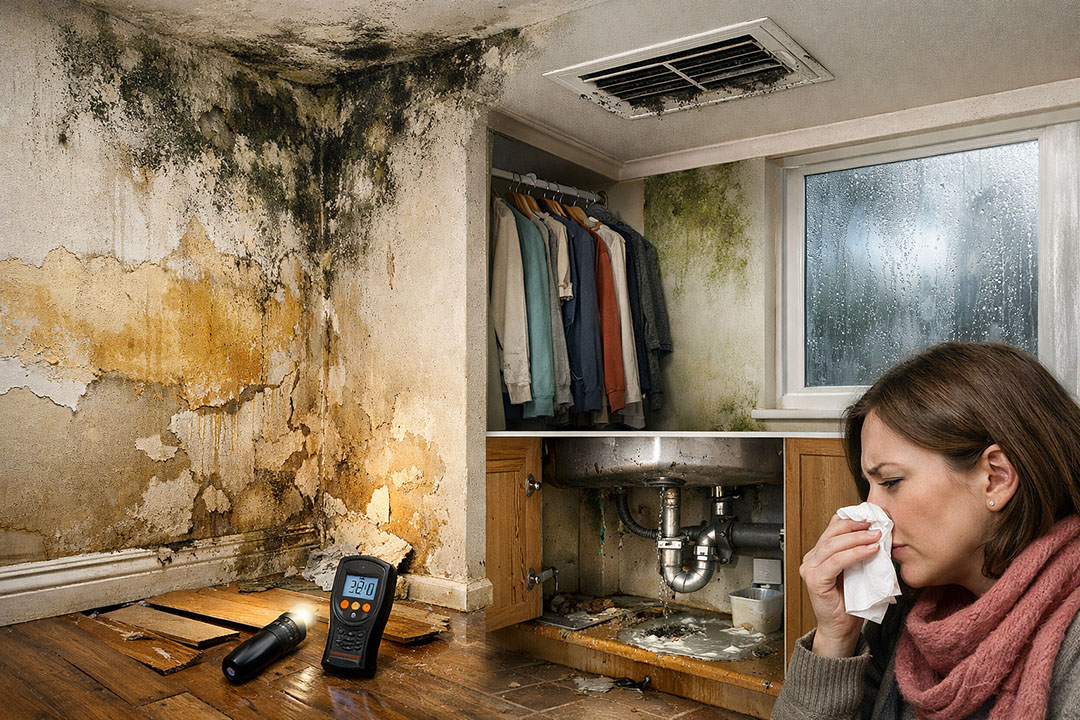
You can often tell you have a mold problem long before you see dramatic black spots on a wall. The key is to watch for a combination of visible clues, persistent odors, moisture history, and even how people feel in the space.
Obvious signs: what you can see
The most straightforward way to spot a mold problem is to look for visible growth and water damage. Indoor mold growth can usually be seen as discolored patches, staining, or fuzzy growth on surfaces.
Common visual signs include:
- Visible mold patches: Spots or clusters that may look black, green, brown, gray, white, or yellow, often fuzzy, slimy, or powdery, on drywall, ceilings, wood, caulking, or around HVAC vents.
- Discolored walls or ceilings: Brown, yellow, or dark stains, sometimes with irregular edges or rings, especially under bathrooms, roofs, or around windows, can signal mold growing on or behind surfaces.
- Peeling or bubbling paint and wallpaper: Cracked, lifting, or bubbling finishes often mean moisture behind the surface, which frequently goes hand‑in‑hand with mold.
- Warped or soft building materials: Swollen baseboards, warped wood, or soft drywall suggest chronic dampness and likely mold inside or behind those materials.
If you see visible mold growth anywhere, you already have a mold problem in that spot, and you should assume there may be more in hidden areas where moisture has traveled.
Trust your nose: the musty odor test
A persistent musty, earthy, or “old basement” smell is one of the most reliable early warning signs of mold, even when you cannot see it yet.
Key odor clues:
- Musty or earthy smell that doesn’t go away with normal cleaning or air fresheners, especially in basements, bathrooms, closets, or near exterior walls.
- Odor that gets stronger in certain areas, after rain, in humid weather, or when the HVAC system runs, suggesting mold in walls, under flooring, or in ducts.
Legal and restoration sources describe musty odors as a “telltale indicator” that you likely have some type of mold or water damage problem, even if you cannot pinpoint it immediately.
Watch how the building affects people
How people feel in your home or business can also be a clue. Mold and dampness often trigger allergy‑like or respiratory symptoms in sensitive individuals.
Warning patterns include:
- Sinus congestion, runny nose, itchy eyes, headaches, or coughing that seem to worsen indoors and improve when you leave.
- Asthma or breathing issues that flare when spending time in particular rooms, such as basements, offices, or bedrooms.
- Pets acting strangely—coughing, labored breathing, or itchy, inflamed skin in a home known to have dampness—can also be a subtle sign.
While symptoms alone don’t “prove” mold, they are an important signal when combined with moisture history or other indicators.
Follow the moisture: leaks, humidity, and condensation
Because mold needs moisture, any building with recurring or past water problems should be on your radar.
Look for:
- Past or current leaks: Roof leaks, plumbing drips, window leaks, and appliance failures; staining, soft materials, or warped surfaces nearby can indicate mold growth.
- Water stains and rings: Brown or yellow stains on ceilings, around light fixtures, or on walls and carpets are common red flags for mold lurking beneath.
- Chronic dampness: Basements or crawl spaces that feel damp, have efflorescence on walls, or show repeated moisture after rain are prime mold zones.
- Condensation: Frequently fogged windows, sweating pipes, or wet spots on cold walls indicate high humidity and surfaces that stay damp long enough for mold to thrive.
If you know an area has been wet for more than 24–48 hours and was never properly dried, you should assume mold may be present, even if it’s currently out of sight.
Simple tools to check more deeply
You do not necessarily need lab tests to confirm a mold problem; many health agencies emphasize that visible or smelled mold is enough reason to act. However, a few inexpensive tools can help you understand the extent and cause:
- Moisture meter: A handheld moisture meter can tell you if drywall, flooring, or framing is damp inside, even when the surface looks dry. Elevated readings compared to nearby “normal” areas often point to hidden moisture and possible hidden mold.
- Humidity monitor (hygrometer): This shows how much moisture is in the air; consistently high indoor humidity (often above 60%) increases mold risk. Many guides recommend maintaining indoor humidity ideally between about 30–50%.
- Flashlight and careful inspection: Using a bright flashlight at a low angle along walls and ceilings can reveal subtle texture changes, faint discoloration, and small colonies that normal lighting hides.
For most homeowners and small business owners, these tools, combined with visual inspection, odors, and moisture history, are more useful than consumer “mold test kits,” which many agencies say are hard to interpret and not necessary for deciding to clean up.
Do you need testing to know you have a problem?
Public health guidance is clear that you usually do not need air or surface testing to decide whether there is a mold issue. Indoor mold growth can usually be seen or smelled, and sampling is not required when visible growth is present. There are no universally accepted “safe” or “unsafe” mold levels for homes, so lab numbers are often less actionable than the basic fact that mold and moisture exist and must be addressed.
Testing may be helpful in limited situations—for example, when there is a strong concern about hidden mold with no visible growth, or when documentation is needed for litigation or some medical situations—but for most property owners, the priority is finding and fixing moisture and removing moldy materials, not getting exact spore counts.
When to call a professional
You can often identify a mold problem yourself, but there are times when bringing in a professional inspector or remediation contractor is wise:
- Strong musty odors with no clear source, especially in multiple rooms or levels.
- Large or recurring visible mold patches, or growth that returns quickly after cleaning.
- Significant water events, like flooding, major roof leaks, or long‑term plumbing leaks.
- Health complaints among occupants that seem tied to time spent in the building.
Professionals can use advanced moisture meters, borescopes, and thermal imaging to locate hidden dampness and mold more precisely, then design a safe remediation plan.
If you see or smell mold, or know you’ve had moisture problems, you can reasonably assume you have a mold problem that needs attention. The real question is not “Do I have mold?” but “Where is it, how extensive is it, and what is causing it?” Paying attention to visual clues, odors, moisture history, and people’s health gives you a powerful toolkit to answer that and decide on next steps.
 Welcome to the Melbourne Mold website. If you have any questions regarding mold at your home or business premises - we are here to help. Please call or complete the form to the right, and we will be in touch at the earliest opportunity.
~ Greg Bertaux