
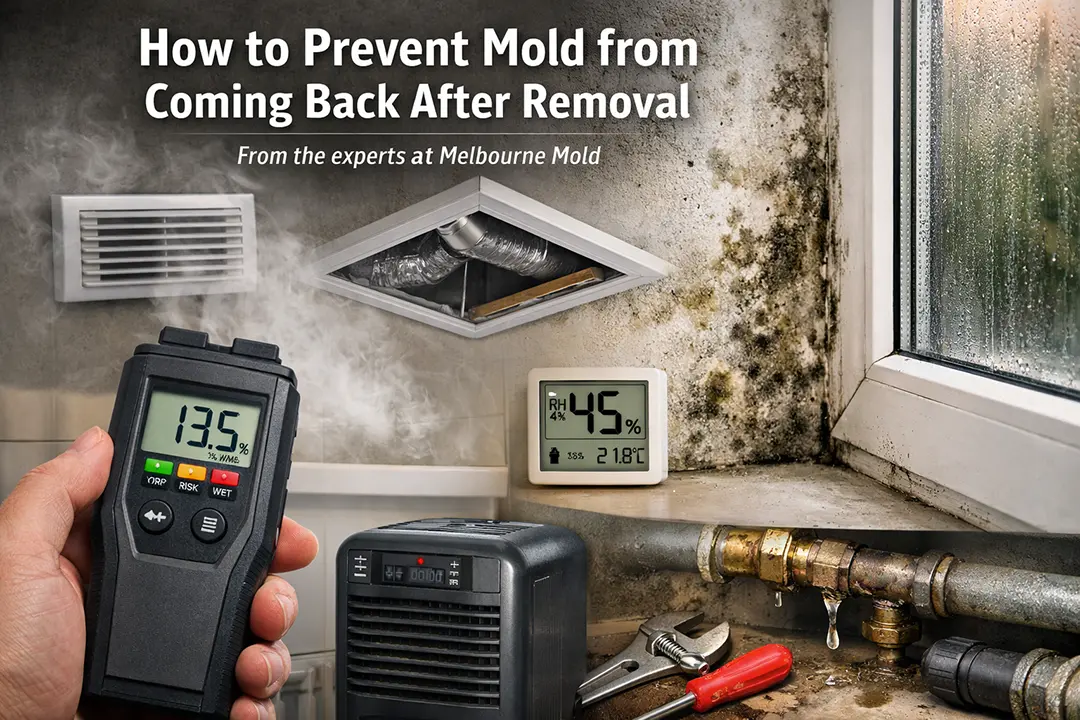
(From the experts at Melbourne Mold)
You’ve invested the time, money, and disruption to have mold removed. The last thing you want is to see it creeping back onto walls, ceilings, or inside closets a few months later. At Melbourne Mold, we tell our clients that remediation is only half the battle; the other half is controlling the conditions that allowed mold to grow in the first place.
In this article, we’ll walk you through why mold returns, what needs to change in your home’s environment, and the practical steps you can take after remediation to keep mold from coming back.
Why Mold Comes Back
From our perspective in the field, mold rarely “comes back” because it survived proper remediation. It usually returns because the underlying moisture problem was never fully resolved.
Mold needs three things to thrive: moisture, a food source (like drywall, wood, dust), and time. You will never remove all food sources or all spores from a building nor do you need to. The controllable factor is moisture. If the same leaks, condensation, or humidity levels continue after remediation, mold often reappears in the same general areas.
The most common reasons we see mold recurring are:
- A hidden or slow leak that was never found, only its surface symptoms were treated.
- Chronic high indoor humidity (often over 60%) due to poor ventilation or undersized/poorly maintained HVAC.
- Condensation on cold surfaces like windows, exterior walls, or ducts in humid spaces.
- Inadequate drying after water damage – materials that looked “dry” on the surface but stayed wet inside.
If you think of remediation as the “treatment,” moisture control is the “lifestyle change” that keeps the problem from returning.
Step 1: Confirm the Moisture Source Was Truly Fixed
At Melbourne Mold, we approach every project with moisture mapping first, not just sampling. After your remediation, you should have a clear answer to one key question: “What was feeding the mold in this area?”
Typical moisture sources include:
- Plumbing leaks (behind showers, under sinks, in slab or wall lines)
- Roof leaks and flashing failures
- Window and door leaks
- Poor grading or drainage, allowing water against the foundation
- Unvented or under-ventilated bathrooms, kitchens, or laundries
- HVAC issues causing condensation or high humidity
If your contractor or inspector cannot clearly tell you what the moisture source was and how it was addressed, that’s a red flag. A strong post-remediation plan includes documentation (photos, measurements, and sometimes moisture readings) showing:
- Where the moisture issue was.
- What was done to stop it (repairs, sealing, drainage improvements, ventilation changes).
- Moisture readings in affected materials showing they are truly dry, not just visually improved.
If you are not confident about the original moisture source, it’s worth getting a second opinion before you assume the problem is solved.
Step 2: Manage Humidity and Ventilation
Even in homes without leaks, we often see mold return in places where humidity is consistently high and air is stagnant—bathrooms, closets on exterior walls, under-stair spaces, and basements or crawlspaces.
After remediation, we recommend homeowners aim for indoor relative humidity in the 40–50% range (and generally below 60%).
Ways to achieve this:
- Use your exhaust fans properly
- Run bathroom fans during showers and for at least 20–30 minutes afterward.
- Ensure kitchen range hoods vent to the outside, not just recirculate.
- Maintain your air conditioning system
- Have coils and drains serviced and cleaned regularly so the system can dehumidify effectively.
- Make sure supply and return vents are not blocked by furniture or curtains.
- Use dehumidifiers where needed
- Basements, crawlspaces, and some ground-level rooms may need dedicated dehumidifiers, especially in humid seasons.
- Choose appropriately sized units and set them to maintain humidity in the recommended range.
Good air movement is a simple but powerful mold deterrent. In problem-prone rooms, ceiling fans or small circulating fans can help minimize stagnant pockets of humid air.
Step 3: Improve Building Details and Habits
From our experience on projects across different types of buildings, small construction details and daily habits make a big difference over time.
Consider the following:
- Insulation and thermal bridges
- Cold spots on poorly insulated exterior walls or around windows can collect condensation. Improving insulation or sealing can reduce these wet surfaces.
- Furniture placement
- When large furniture is pushed tight against exterior walls, air cannot circulate, and condensation plus mold often form behind it. Try to maintain a small gap for airflow.
- Flooring and rugs
- Keep an eye on rugs in damp-prone areas (near exterior doors, bathrooms, below windows). If they routinely get damp, adjust drainage, sealing, or habits so they can dry quickly or relocate them.
- Drying clothes
- Avoid drying clothes indoors without adequate ventilation or a vented dryer. Moisture from laundry can significantly raise indoor humidity.
- Regular cleaning
- Dust acts as a food source for mold, especially on vents, window sills, and in corners. Regular cleaning, particularly where condensation can occur, reduces available nutrients.
These are not dramatic renovations, but in aggregate they change the environment enough to make regrowth much less likely.
Step 4: Monitor High-Risk Areas After Remediation
We tell Melbourne Mold clients that the months immediately after remediation are the best time to be extra observant. If a moisture problem hasn’t been fully resolved, subtle signs often appear fairly quickly.
Monitor:
- Previously affected rooms, especially corners, ceiling-wall junctions, behind furniture, and near windows.
- Areas near fixed moisture sources – bathrooms, kitchens, laundry rooms.
- HVAC and ductwork, especially where ducts run through unconditioned spaces.
Watch for:
- New or persistent musty odors.
- Discoloration or spotting on painted surfaces, caulk, or grout.
- Peeling paint, blistering, or new stains.
- Condensation forming regularly on windows or cold surfaces.
Simple digital hygrometers (humidity meters) placed around the home can give you early warning if conditions are drifting into a mold-friendly range.
Step 5: Know When to Call for Help Again
No homeowner wants to be on a first-name basis with a mold company. Our goal at Melbourne Mold is to see you once, solve the problem properly, and then equip you so you don’t need us again.
However, you should reach back out to a professional if:
- You see visible mold returning in the same area that was remediated.
- You notice persistent musty odors that cannot be traced to obvious, minor causes.
- Humidity stays high despite your best efforts, suggesting an underlying mechanical or building issue.
- You suspect a new leak or water intrusion (roof, plumbing, storm event).
When you call, share as much detail as possible: what was remediated, what repairs were done, what conditions you’ve observed since, and any measurements you’ve taken (humidity, moisture readings if available). This helps your assessor focus quickly on what may have been missed or what has changed.
The Melbourne Mold Approach
From our perspective, preventing mold from coming back is not a mystery; it’s a process. A thorough investigation, targeted remediation, and a clear moisture-control strategy all have to work together. If any one of those three is weak, regrowth remains a real risk.
As a mold testing and assessment company, Melbourne Mold focuses heavily on:
- Identifying and documenting sources of moisture.
- Providing practical, prioritized recommendations you can act on with your chosen contractors.
- Educating you on how to maintain your home’s environment long after we leave.
If you’ve already gone through remediation and want to be sure your home is set up to stay mold-resistant, a focused post-remediation assessment and moisture strategy session can provide peace of mind and help ensure this is the last time you have to deal with a major mold problem.
 Welcome to the Melbourne Mold website. If you have any questions regarding mold at your home or business premises - we are here to help. Please call or complete the form to the right, and we will be in touch at the earliest opportunity.
~ Greg Bertaux