
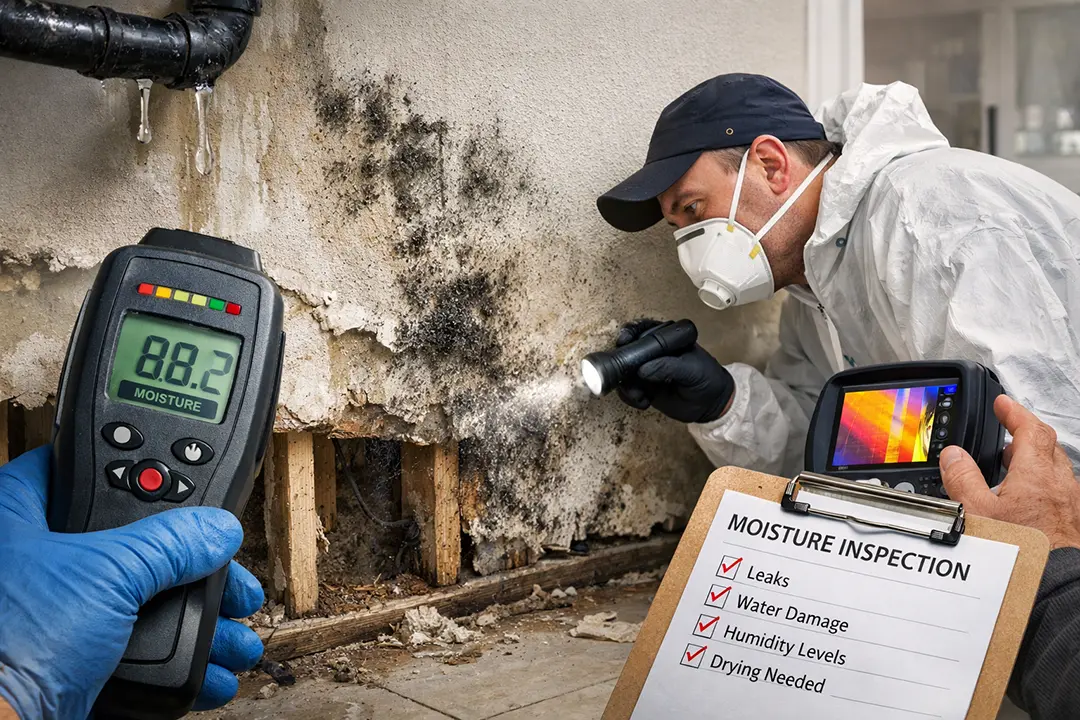
State and public‑health agencies across the U.S. are quietly reshaping how homeowners, tenants, and professionals think about mold testing, moving the focus away from “what kind of mold is it?” and toward “where is the moisture and how do we fix it?” This shift has big implications for when testing is recommended, what regulators expect, and how you, as a property owner or inspector, should communicate about mold concerns.
Why public agencies downplay routine mold testing
Public‑health organizations consistently repeat a core message: if you can see or smell mold, you already have enough information to act. The Centers for Disease Control and Prevention (CDC) notes that large mold infestations can usually be seen or smelled, and that you do not need to know the exact type of mold before deciding to remove it. The U.S. Environmental Protection Agency (EPA) similarly states that when visible mold growth is present, sampling is generally unnecessary because there are no federal limits for mold levels that a test could compare against.
State health departments echo this stance. Tennessee’s health department, for example, explains that both CDC and EPA do not recommend routine mold testing and that the presence of mold should lead directly to cleanup and prevention, regardless of species. This message is designed to keep homeowners from delaying remediation while they “wait for lab results” that will not change the basic response: clean it up and correct the moisture problem.
Florida’s guidance: focus on moisture, not mold type
In Florida, where heat, humidity, and storms all drive mold growth, the Department of Health emphasizes moisture control and building conditions rather than broad screening. Florida’s official mold information warns that excess moisture is the root cause, and that preventing and repairing leaks, controlling humidity, and quickly drying wet materials after water events are the most effective strategies. The agency directs residents to clean small areas of mold promptly and to seek qualified help for larger or complex contamination, again without insisting on species identification first.
Florida also ties mold to licensing and professional practice. The Department of Health points residents to statutes governing mold assessors and remediators, reinforcing the idea that when testing or large‑scale remediation is necessary, it should be done by qualified professionals operating under state rules. This helps separate casual, fear‑based testing from targeted investigations with a clear purpose, such as documenting damage or guiding a remediation plan.
Why many agencies question the value of “routine” mold testing
Several scientific and practical reasons sit behind the public‑health skepticism toward routine testing. EPA notes that no federal exposure limits exist for mold, so a lab report showing a certain spore count cannot be used to say a building is “safe” or “unsafe” in the way a lead or asbestos test might. Federal guidance also stresses that sampling must be designed and interpreted by professionals, and that analysis should follow recognized methods from organizations like AIHA or ACGIH to have any reliability at all.
Emerging federal mold‑assessment guidelines highlight the limitations of common methods such as spore‑trap air sampling. Drafted guidance cites literature indicating that sampling and analytical error for spore traps can range from about 30 percent up to 200 percent, depending on loading and conditions, which makes precise risk assessment difficult. These documents emphasize that decisions should start with a thorough visual inspection supported by tools like moisture meters and thermal imaging, and that sampling should only occur when there is a clearly defined goal.
When testing is still recommended
None of this means testing is “bad” or obsolete; it means random or fear‑driven sampling is discouraged. EPA acknowledges that surface sampling can be useful in post‑remediation verification (PRV) to determine whether an area has been adequately cleaned. Federal mold‑assessment guidance likewise notes that air sampling may be necessary in specific situations, such as when individuals have documented illnesses associated with fungal exposure, or when you need to evaluate hidden contamination in complex structures.
Professional industrial hygiene organizations take a middle ground. The American Industrial Hygiene Association (AIHA), as cited in commentary on CDC guidance, argues that investigation and remediation should be based on an informed inspection and that sampling has a role when used judiciously to detect hidden damage or clarify uncertain findings. In other words, the problem is not testing itself, but testing without a question, a plan, or a path to decisions.
What this means for homeowners and tenants
For the public, the shift in guidance changes the first instinct from “call a lab” to “look, smell, and investigate moisture.” Agencies advise residents to look for visible growth, water staining, and damp materials, notice musty odors, and check for leaks or condensation around windows, plumbing, roofs, and HVAC systems. Small, accessible areas can often be cleaned following agency‑recommended safety tips, while widespread growth or mold in HVAC systems should trigger professional help.
Public‑health messaging also pushes people to act quickly rather than wait for laboratory confirmation. Because mold can start growing within 24–48 hours on wet materials, agencies emphasize rapid drying after floods or leaks, discarding porous materials that cannot be fully cleaned, and correcting the moisture source to avoid repeat problems. This proactive approach is presented as more protective of health than extended debates over whether a specific mold species is “toxic.”
Implications for inspectors, remediators, and consultants
For professionals in mold assessment and remediation, this evolving public‑health guidance creates both challenges and opportunities. On one hand, agencies explicitly stating that routine testing is not needed can undermine low‑value services that sell panels of samples without clear interpretation or building science insight. On the other hand, it elevates the role of thorough inspection, moisture diagnostics, and clear communication about what testing can and cannot do.
Emerging federal guidelines and state statutes are also laying the groundwork for more standardized expectations around how and when to use sampling. Proposed mold‑assessment frameworks call for clearly defined sampling goals, documented plans, and integration of findings with visual, moisture, and building‑history data. Florida’s move to develop mold remediation guidelines based on up‑to‑date scientific data and permissible exposure limits underlines how state agencies are trying to convert scattered scientific evidence into practical tools for regulators and practitioners.
For consultants and content creators working in this space, the key narrative is clear: public‑health agencies are not “anti‑testing,” they are pro‑evidence‑based, targeted testing anchored in solid building science. The future of mold work will belong to those who can explain that distinction to clients, pair inspections with appropriate sampling when justified, and focus every recommendation on the ultimate objective: controlling moisture, restoring healthy indoor environments, and documenting that the job was done right.
 Welcome to the Melbourne Mold website. If you have any questions regarding mold at your home or business premises - we are here to help. Please call or complete the form to the right, and we will be in touch at the earliest opportunity.
~ Greg Bertaux